Smoke Damage Restoration in Fair Lawn
24/7 smoke damage restoration in Fair Lawn, NJ. IICRC-certified, insurance billing accepted. Call (855) 650-7422.
Our IICRC-certified technicians are headquartered right here in Fair Lawn and are typically on-site within 60 minutes of your call.
A kitchen fire in a Radburn colonial or a furnace flare-up in one of Fair Lawn’s postwar capes leaves more than char behind — smoke travels through ductwork, seeps into plaster walls, and settles into every soft surface within minutes. By the time the fire department clears the scene, odor molecules and acidic soot particles have already begun etching metal fixtures, yellowing paint, and embedding themselves in insulation. The Restoration Group operates around the clock, and because our crews are based in Kenilworth, we can reach any address in the 07410 ZIP code quickly — before secondary smoke damage compounds the loss.
Why Fair Lawn Homes Are Particularly Vulnerable to Smoke Damage
Fair Lawn’s housing stock tells the story. The Radburn Historic District — one of the first planned communities in the United States, built in the late 1920s and early 1930s — is full of homes with original plaster-and-lath walls, unlined brick chimneys, and minimal vapor barriers. Those materials behave very differently during a smoke event than modern drywall does. Plaster is porous at a microscopic level, meaning smoke residue penetrates the surface layer and binds to the substrate rather than sitting on top of it. Standard surface wiping is not enough; technicians need to treat the wall system, not just the face.
The postwar capes and colonials along Warren Point and Columbia Heights add another layer of complexity. Many were built with open-joist basements and minimal compartmentalization between floors, so smoke from a first-floor fire migrates upward through wall cavities and re-enters living spaces through electrical outlets and trim gaps on the second floor. Homes along River Road and the lower Saddle River Road corridor also tend to have older HVAC systems with ductwork that hasn’t been replaced since the 1970s — once smoke enters those ducts, the entire system becomes a distribution network for odor and fine particulate.
Our Smoke Damage Restoration Process in Fair Lawn
When a crew arrives at a Fair Lawn property, the first priority is scope documentation — not just the rooms with visible char, but every space smoke could have reached. That means pulling HVAC registers, checking attic cavities, and probing wall assemblies with moisture and particle meters. Insurance carriers want this documentation, and it protects homeowners from discovering hidden damage months later.
From there, the process moves through four concrete phases:
1. Containment and air scrubbing. HEPA air scrubbers and negative-pressure units are staged to capture fine soot particles still suspended in the air. This step matters especially in Fair Lawn’s older homes, where gaps in the building envelope mean smoke particles can migrate to unaffected rooms if airflow isn’t controlled.
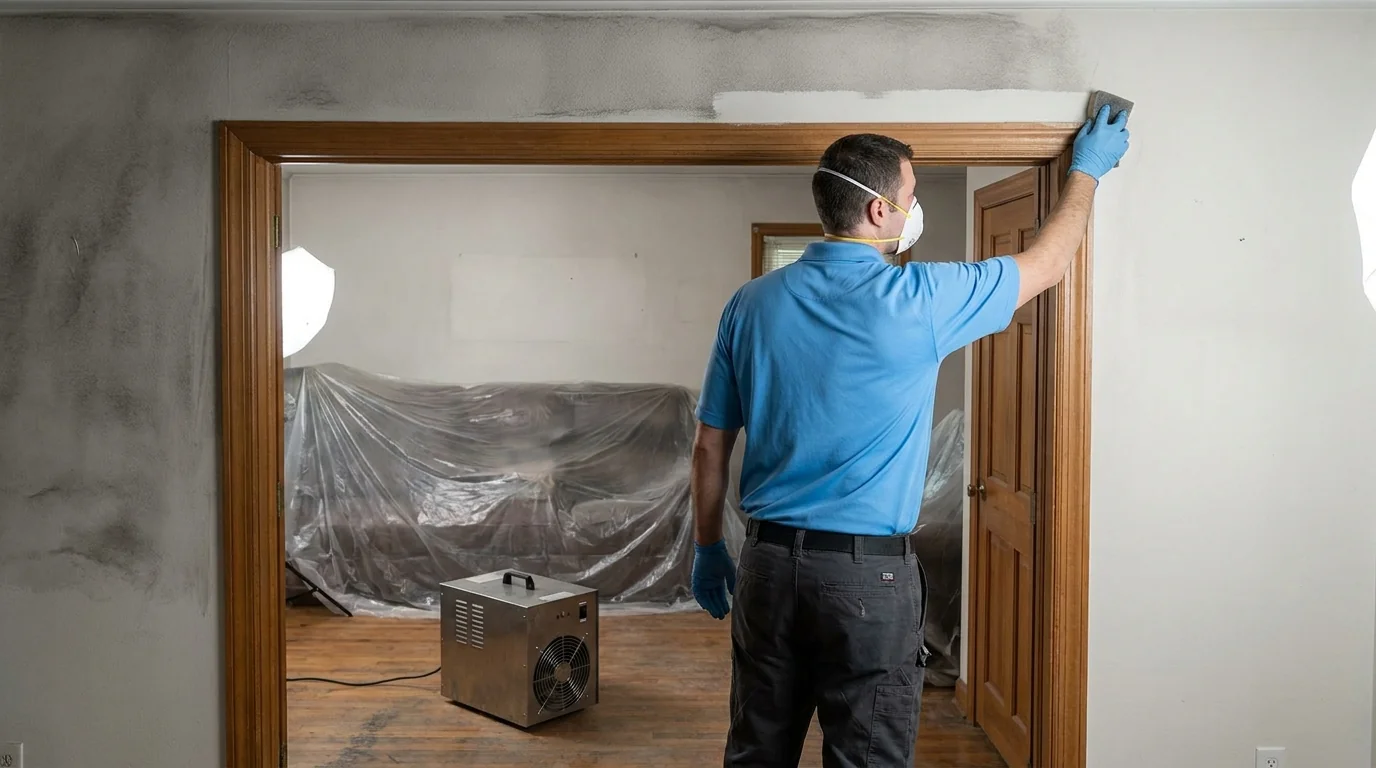
2. Dry and wet residue removal. Dry chemical sponges lift loose soot from ceilings and walls before any liquid cleaner is applied — wetting loose soot first drives it deeper into porous surfaces. Technicians then follow with alkaline or acidic cleaners matched to the residue type: protein smoke from a kitchen fire requires a different chemistry than the heavy carbon soot left by a structural fire.
3. Odor neutralization. Thermal fogging and hydroxyl generators are used on the structure itself. For Radburn-era homes with original hardwood floors and plaster walls, hydroxyl treatment is often preferred over ozone because it is safe to run while contents remain in the space and does not degrade rubber seals or aged finishes.
4. Content and HVAC cleaning. Ductwork is cleaned and sealed or lined where necessary. Salvageable contents — furniture, clothing, documents — are inventoried and either cleaned on-site or packed out to a controlled facility.
All drying and deodorization work is performed in accordance with IICRC standards, and The Restoration Group holds IICRC Certified Firm status (#210213).
Reaching Fair Lawn from Kenilworth
Kenilworth sits roughly 12 miles south of Fair Lawn via Route 17 or the Garden State Parkway to Route 208. Because the company operates 24/7, crews can be dispatched at any hour. The Broadway commercial district and Fair Lawn Avenue corridor — where older retail buildings with flat roofs and aging electrical panels see a disproportionate share of fire calls — are accessible directly off Route 208 East. Residential neighborhoods like Radburn and Warren Point are a short drive from the interchange. Dispatchers route crews based on current traffic, and Fair Lawn’s relatively compact footprint means most addresses can be reached in a single run from the highway.
Local Note
One pattern that comes up repeatedly in Fair Lawn’s older Radburn-area homes: the original plaster walls contain a lime-based finish coat that reacts with acidic smoke residue to produce a persistent yellowish staining that looks like nicotine discoloration. Homeowners sometimes assume the walls need to be replaced entirely, but in most cases a proper alkaline neutralizing wash followed by a shellac-based primer seals the substrate and allows repainting without full demolition. Preserving original plaster matters in the Radburn Historic District, where the character of the wall finish is part of the home’s architectural integrity — and where full drywall replacement would require more extensive work than the smoke damage itself.
If smoke has moved through your Fair Lawn home or commercial property, the window for limiting secondary damage is short. Call The Restoration Group at (855) 650-7422 — crews are available around the clock, and we handle documentation and direct billing to most major insurance carriers so you are not managing the paperwork alone during an already difficult time.
Headquartered right here in Fair Lawn — ★ 4.8 · 158 Google reviews
“Very professional staff and also helped accommodate working around some other contractors that were simultaneously working in my house. Highly recommend!” — Gautam, July 2026Read our reviews on Google →
Smoke Damage Restoration in Fair Lawn: Service Coverage
Frequently Asked Questions
How fast can you arrive for smoke damage restoration in Fair Lawn?
How quickly can The Restoration Group reach a smoke damage emergency in the Radburn or Warren Point area of Fair Lawn?
Fair Lawn's Radburn Historic District has original plaster walls — does that change how smoke residue is cleaned?
Homes along River Road in Fair Lawn often have older HVAC systems — how does smoke in the ductwork get addressed?
What type of smoke residue is hardest to remove, and is it common in Fair Lawn kitchen fires?
Will my homeowner's insurance cover smoke damage restoration in Fair Lawn, and does The Restoration Group handle the claim paperwork?
Smoke Damage Restoration response in Fair Lawn
Most Fair Lawn calls see a technician on-site within 60 minutes from our Fair Lawn headquarters.