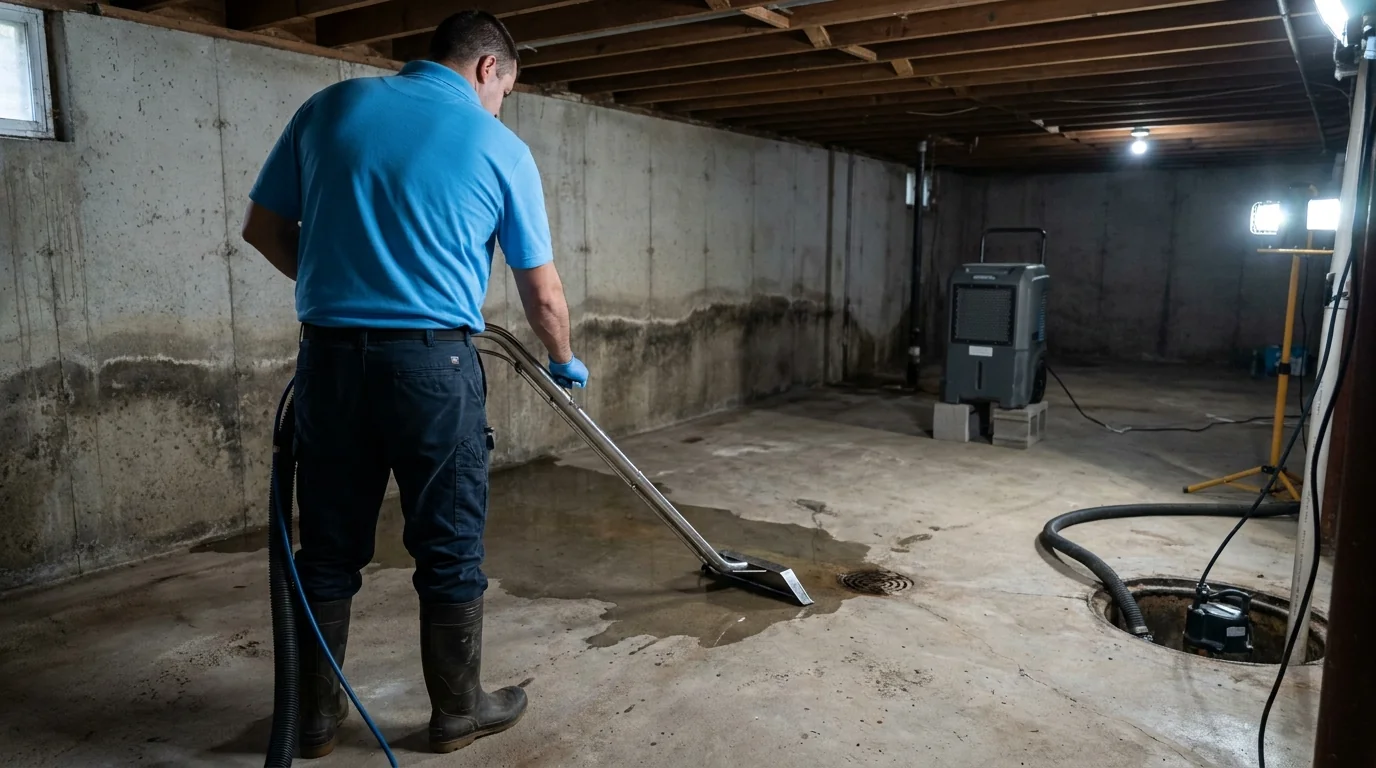
Basement Flooding Cleanup in Fair Lawn
24/7 basement flooding cleanup in Fair Lawn, NJ. IICRC-certified, insurance billing accepted. Call (855) 650-7422.
Our IICRC-certified technicians are headquartered right here in Fair Lawn and are typically on-site within 60 minutes of your call.
When the Passaic River backs up or a nor’easter drops three inches overnight, basements along River Road and Saddle River Road don’t just get damp — they fill. Fair Lawn’s position between two flood-prone waterways means that what looks like a routine wet-basement call often involves a foot of standing water, saturated framing, and a clock already ticking on mold colonization. The Restoration Group operates 24/7 out of Kenilworth, putting crews into Fair Lawn (07410) fast, whether the call comes from a postwar colonial near Memorial Park or a 1930s Radburn row home with a finished basement.
Why Fair Lawn Properties See Repeated Basement Flooding
Fair Lawn’s geography stacks the odds against dry basements. The Saddle River threads the borough’s eastern edge and the Passaic defines the south — both waterways overtopped dramatically during Ida in 2021, and the low-lying corridors between them stay saturated well after a storm passes. Hydrostatic pressure builds in the clay-heavy soil, forcing water through foundation cracks and floor-wall joints even when there’s no visible surface flooding.
The housing stock adds another layer of risk. Radburn’s planned-community homes from the late 1920s and early 1930s were built before modern waterproofing standards existed. Many still have original cast-iron drain lines that have corroded, scaled, or shifted over ninety-plus years. A slow drain during a heavy rain becomes a backup in minutes. Postwar capes and colonials throughout Warren Point and Columbia Heights often have finished basements — drywall, carpet, drop ceilings — that absorb water silently until the damage is already extensive. Supply lines in those homes are frequently original copper or galvanized steel, and a single pinhole failure behind a finished wall can saturate insulation for days before anyone notices.
Along the Broadway commercial corridor, older retail and mixed-use buildings carry their own risk profile: flat or low-slope roofs, aging cast-iron mains, and basement mechanical rooms that flood before anyone opens for business.
Our Basement Flooding Cleanup Process in Fair Lawn
Every job starts with a moisture assessment before a single pump runs. We use thermal imaging and calibrated moisture meters to map where water has traveled — under slab, behind finished walls, into subfloor assemblies — because what you can see is rarely the full picture in an older Fair Lawn home.
Once the scope is mapped, the sequence is:
- Standing water extraction using truck-mounted and portable extractors. In finished basements, we remove saturated carpet and pad immediately — they hold water against the subfloor and accelerate structural damage.
- Structural drying with industrial desiccant or refrigerant dehumidifiers and high-velocity air movers, positioned to create directed airflow through wall cavities and under flooring.
- Antimicrobial treatment on affected surfaces. At typical indoor temperatures, mold can begin colonizing wet organic material within 24–48 hours — in a warm Fair Lawn basement in July, that window is on the shorter end.
- Moisture verification before any rebuild begins. We don’t close a job until readings confirm materials have returned to acceptable dry standards per the IICRC S500 protocol.
For homes with original plaster or lathe construction — common in the Radburn Historic District — drying timelines run longer than in modern drywall construction. Plaster releases absorbed moisture slowly and unevenly, so we extend monitoring cycles rather than pulling equipment prematurely.
Reaching Fair Lawn from Kenilworth
The Restoration Group’s Kenilworth location puts Fair Lawn within a direct run up Route 21 or the Garden State Parkway to Route 208. Because we operate around the clock, a call at 2 a.m. during a storm event gets the same crew dispatch as a midday call. We stage equipment in the truck before leaving, so extraction starts as soon as we’re on-site — not after a second trip for gear.
For addresses near Saddle River County Park or along the River Road flood corridor, we factor in road-closure conditions during active storm events and route accordingly. If access to your street is compromised, we communicate that immediately rather than leaving you waiting.
Insurance Coordination for Fair Lawn Homeowners
Most standard homeowners policies in New Jersey distinguish between sudden-and-accidental water losses (a burst pipe, an appliance failure) and flood losses (rising groundwater, overland flow). If your basement flooded during Ida or a similar event, the cause of loss matters significantly for what your carrier will cover. We document the loss thoroughly — photographs, moisture readings, affected material inventories — and provide the paperwork your adjuster needs. We bill most major carriers directly and can walk you through the distinction between a standard HO-3 claim and a separate NFIP flood policy if you carry one.
Local Note
In the Radburn Historic District, homes built in the late 1920s often have basement floors poured at a lower elevation than the street-side storm drain inlets — a design that made sense for the era but means that during a surcharge event, water can actually flow backward through floor drains. If you’re in Radburn and your floor drain is gurgling or bubbling during heavy rain, that’s not a slow drain — it’s a sign the municipal system is overwhelmed and your basement is the path of least resistance. A backwater valve installation is the long-term fix; in the short term, call us before the water is already in.
Flooded basements in Fair Lawn move fast from inconvenience to structural damage to mold risk. If you’re standing in water right now — or watching it rise — call The Restoration Group at (855) 650-7422. We’re available 24/7, we know this borough, and we’ll have a crew moving toward you.
Headquartered right here in Fair Lawn — ★ 4.8 · 158 Google reviews
“Very professional staff and also helped accommodate working around some other contractors that were simultaneously working in my house. Highly recommend!” — Gautam, July 2026Read our reviews on Google →
Basement Flooding Cleanup in Fair Lawn: Service Coverage
Frequently Asked Questions
How fast can you arrive for basement flooding cleanup in Fair Lawn?
How quickly can The Restoration Group reach a flooded basement in the River Road or Saddle River Road area of Fair Lawn?
Are Radburn homes more vulnerable to basement flooding than newer Fair Lawn construction?
My Fair Lawn basement flooded during a storm — will my homeowners insurance cover the cleanup?
How long does basement drying typically take in an older Fair Lawn home with a finished basement?
What's the mold risk after a basement flood in Fair Lawn's summer humidity?
Basement Flooding Cleanup response in Fair Lawn
Most Fair Lawn calls see a technician on-site within 60 minutes from our Fair Lawn headquarters.