Flood Damage Restoration in Englewood
24/7 flood damage restoration in Englewood, NJ. IICRC-certified, insurance billing accepted. Call (855) 650-7422.
Our IICRC-certified technicians are dispatched from our Fair Lawn, NJ headquarters and are typically on-site in Englewood within 60 minutes of your call.
When Flat Rock Brook backs up after a heavy rain or an aging supply line gives out inside one of East Hill’s century-old Victorians, the water doesn’t wait for business hours. Englewood’s mix of grand pre-war estates, dense early-1900s multifamily buildings, and postwar row houses on the west side means flood events here range from finished-basement inundations to commercial sprinkler discharges along the Palisade Avenue corridor — and the structural stakes are different at every address. The Restoration Group responds 24/7, dispatching from Kenilworth to begin extraction before standing water has time to migrate into subfloor assemblies and wall cavities.
Why Englewood Properties See Flood Damage Differently
Englewood’s topography does a lot of the explaining. Low-lying streets near Overpeck Creek tributaries flooded significantly during Tropical Storm Ida in 2021, and that same drainage pattern means any sustained rainfall event can push water toward finished lower levels in the Fourth Ward and West Englewood. Uphill, the East Hill estate district presents a different challenge: large homes built before 1940 often have stone or brick foundation walls with limited waterproofing, cast-iron drain stacks that corrode from the inside out, and plaster-over-lath interior walls that absorb moisture slowly and release it even more slowly during drying. A flood that would dry in three days inside modern drywall construction can require five to seven days of monitored drying in those older assemblies.
The Palisade Avenue business district adds a commercial dimension. Restaurants and retail spaces with floor drains, grease traps, and overnight sprinkler systems generate losses that look nothing like a residential pipe burst — contamination categories are higher, documentation requirements for commercial insurance are more detailed, and tenant-landlord coordination adds a layer of complexity that purely residential crews aren’t always equipped to handle.
Our Flood Damage Restoration Process in Englewood
Every job starts with a moisture mapping walk-through. Technicians use thermal imaging and pin-type moisture meters to trace exactly how far water has traveled — behind baseboards, under hardwood floors, into adjacent rooms. In Englewood’s older housing stock, water frequently wicks further than it appears on the surface, so we map before we cut.
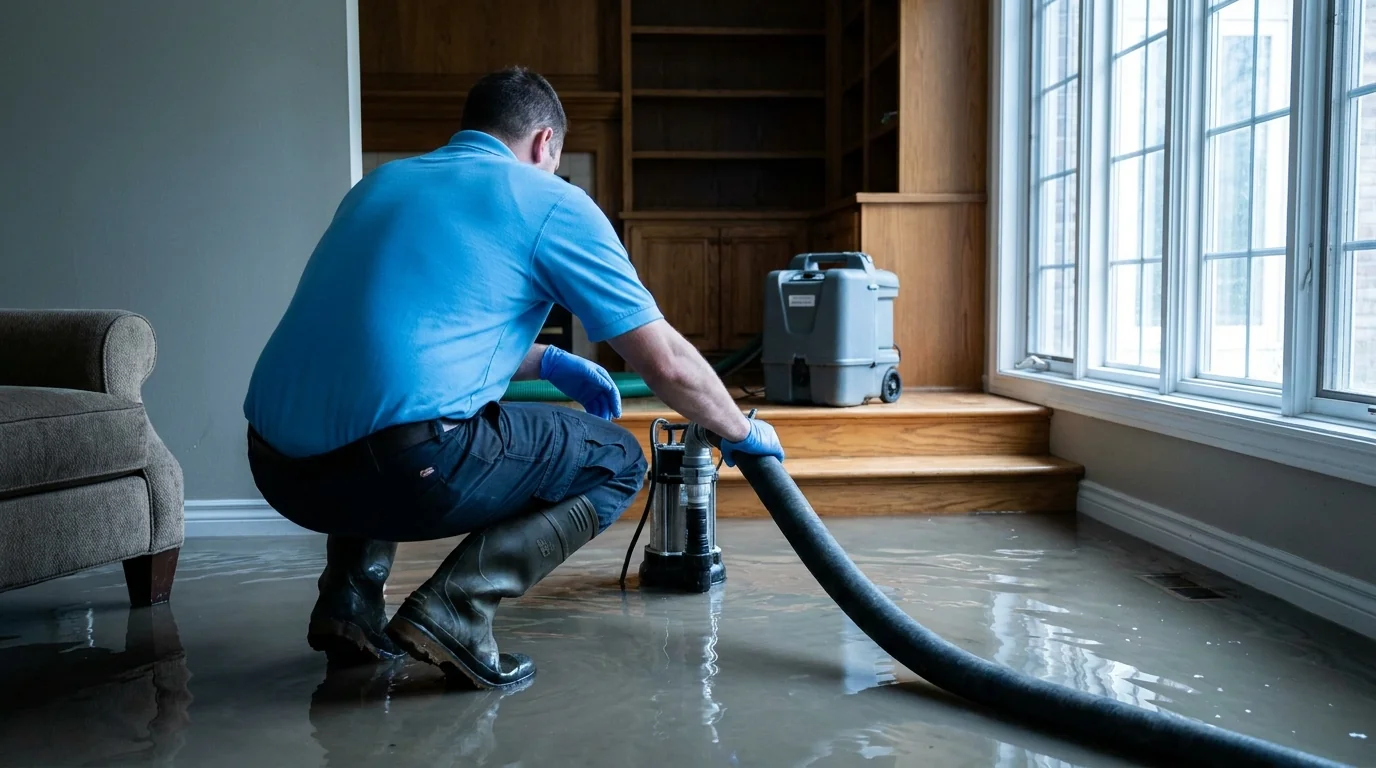
Extraction comes next: truck-mounted and portable units pull standing water and surface saturation from carpet, hardwood, concrete, and crawl spaces. Once bulk water is removed, the drying phase begins using commercial-grade desiccant and refrigerant dehumidifiers alongside high-velocity air movers, positioned according to the IICRC S500 standard for structural drying. Moisture readings are logged at every visit so the drying curve is documented — a record that matters both for insurance adjusters and for confirming the structure is genuinely dry before any reconstruction begins.
For contaminated flood water — Category 2 or Category 3 losses involving sewage backup or exterior floodwater — affected porous materials are removed and bagged on-site, and antimicrobial treatment is applied to framing and concrete before drying equipment is set. We hold IICRC Certified Firm status (#210213) and are licensed as an NJ Home Improvement Contractor through the NJ Division of Consumer Affairs, so the paperwork trail is clean from first call through final inspection.
Reaching Englewood from Kenilworth
Kenilworth to Englewood runs roughly 25 miles via Route 3 East and the Garden State Parkway North, or through local routes depending on traffic. Because the team operates around the clock, a call placed at 2 a.m. after a pipe failure in a Highwood apartment building or a basement flood near the Dwight-Englewood School corridor gets the same dispatch priority as a midday call. Crews stage equipment in the vehicle before departure so extraction can begin within minutes of arrival rather than after a separate equipment setup.
Local Note
One pattern that comes up repeatedly in Englewood’s East Hill and older Fourth Ward properties: finished basements with drop ceilings installed over original plaster or concrete block. When flood water enters, it pools invisibly above the drop-ceiling tiles and saturates the space between the suspended grid and the structural ceiling — sometimes for days before the homeowner notices. By that point, mold colonization can begin on the organic material in ceiling tiles and any wood framing above. On those jobs, we always remove ceiling tiles and inspect the cavity above before setting drying equipment, even when the visible damage looks minor. Skipping that step is one of the most common reasons a flood job gets called back.
Englewood Insurance Coordination
Most residential flood losses in the 07631 ZIP code fall under standard homeowners policies for sudden and accidental discharge, while true surface flooding from events like Ida typically routes through NFIP (National Flood Insurance Program) policies. The documentation requirements differ. We photograph and log affected materials, square footage, and moisture readings in a format that supports both claim types, and we communicate directly with adjusters to keep the scope of work aligned with what the policy covers. For commercial properties along Palisade Avenue or multi-unit buildings, we coordinate with property managers and their carriers simultaneously so tenants aren’t left waiting on competing approval chains.
If you’re dealing with standing water or soaked materials at an Englewood property right now, call (855) 650-7422. The faster extraction begins, the narrower the damage footprint — and the lower the final restoration cost.
Serving Englewood from our Fair Lawn headquarters — ★ 4.8 · 158 Google reviews
“Very professional staff and also helped accommodate working around some other contractors that were simultaneously working in my house. Highly recommend!” — Gautam, July 2026Read our reviews on Google →
Flood Damage Restoration in Englewood: Service Coverage
Frequently Asked Questions
How fast can you arrive for flood damage restoration in Englewood?
How quickly can The Restoration Group reach a flooded property in West Englewood or the Fourth Ward?
Englewood's East Hill homes are mostly pre-1940 construction — does that change how flood drying works?
My Englewood basement flooded during a storm — is that covered differently than a pipe burst?
What does Category 3 flood water mean, and is it common in Englewood's older housing stock?
Can you handle a commercial flood loss on the Palisade Avenue corridor, not just residential properties?
Will my homeowners insurance cover flood damage restoration in Englewood?
Flood Damage Restoration response in Englewood
Most Englewood calls see a technician on-site within 60 minutes from our Fair Lawn headquarters.