24/7 Emergency Smoke Damage Restoration in East Brunswick
24/7 emergency smoke damage restoration in East Brunswick, NJ. IICRC-certified, insurance billing accepted. Call (855) 650-7422.
Our IICRC-certified technicians are dispatched from our Fair Lawn, NJ headquarters and are typically on-site in East Brunswick within 60 minutes of your call.
Smoke damage emergency in East Brunswick? We answer 24/7. Call now and our crew can be on-site within 60 minutes to stop smoke and soot damage from spreading.
When a kitchen fire tears through one of East Brunswick’s 1960s split-levels off Old Bridge Turnpike, the smoke doesn’t just blacken the ceiling above the stove, it travels. It rides the return-air ducts, seeps into the fiberglass insulation packed between floor joists, and settles into the finished basement that nearly every home in this zip code (08816) was built with. By the time the fire department clears the scene, odor molecules are already bonding to painted drywall, carpet padding, and the decades of accumulated particulate in ductwork that hasn’t been replaced since the Carter administration. That’s the starting point for smoke damage restoration in East Brunswick, not a surface wipe-down, but a systematic, room-by-room recovery.
Why East Brunswick Homes Are Especially Vulnerable to Smoke Damage
The postwar building stock that defines most of East Brunswick’s residential neighborhoods, ranches, colonials, and split-levels built between roughly 1952 and 1978, shares a few traits that make smoke damage harder to contain and longer to remediate than in newer construction.
First, these homes were built before modern air-sealing standards existed. Wall cavities communicate freely with attic spaces and basement voids, which means combustion byproducts from even a contained kitchen or garage fire can migrate to rooms that appear untouched. A homeowner in the Frost Woods area who had a laundry-room fire told us the master bedroom on the opposite end of the house smelled like smoke for weeks after a previous contractor “cleaned” it, because nobody had addressed the shared wall cavity running the full length of the structure.
Second, many of these homes still have original cast-iron HVAC plenum systems or early-generation forced-air furnaces. Smoke aerosols and soot particles are drawn into the return and re-deposited on every surface the air touches. Skipping duct inspection and cleaning after a fire is one of the most common reasons smoke odor returns months later.
Finally, East Brunswick’s humid summers, amplified in low-lying sections near Lawrence Brook, mean residual smoke compounds absorb ambient moisture and off-gas more persistently than they would in a drier climate. Protein smoke from a kitchen fire, which is nearly invisible but intensely odorous, is particularly stubborn in humid conditions.
Our Smoke Damage Restoration Process in East Brunswick
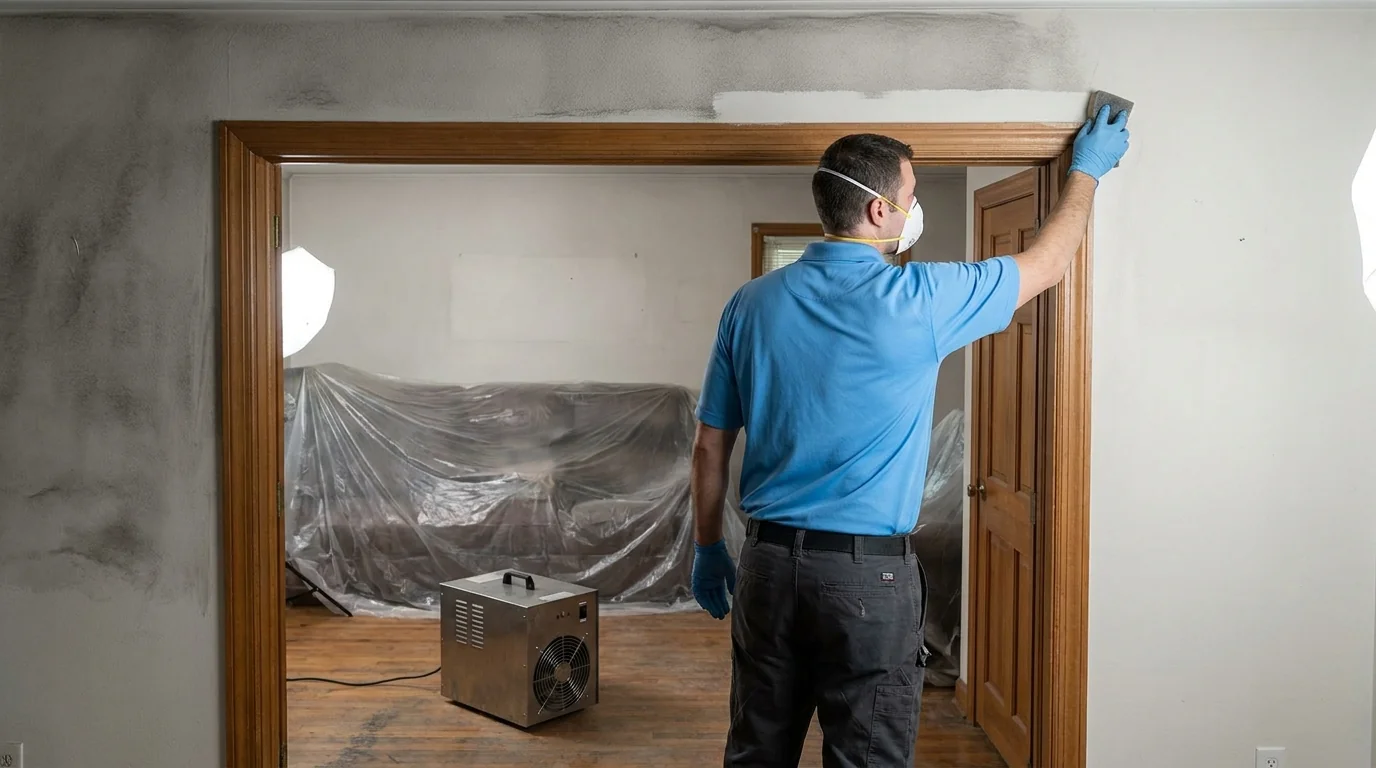
Every job starts with a structured assessment before any cleaning begins. We identify the fire’s origin point, map the smoke migration path through the structure, and test surfaces with a chemical sponge and pH strips to distinguish dry soot from wet smoke residue, the two behave differently and require different chemistry.
For the split-levels and ranches common in neighborhoods like Tanglewood and Farrington, that migration mapping almost always extends to the basement. Finished lower levels in these homes typically share open joist bays with the floor above, and smoke travels down as readily as it travels up when the pressure differential is right.
Once the scope is defined, the process moves through these phases:
- Structural surface cleaning: HEPA-vacuuming loose soot before any wet cleaning prevents smearing. Dry chemical sponges lift dry smoke from walls and ceilings without water activation.
- Odor neutralization: Thermal fogging and hydroxyl generation reach the same porous surfaces, wood framing, insulation, subfloor, that smoke reached. We do not mask odor with fragrance; we break down the odor compounds chemically.
- HVAC and duct cleaning: Soot-contaminated ductwork is cleaned and treated before the system is run again. Running a contaminated system re-distributes smoke residue to every room.
- Content and pack-out: Furniture, clothing, and personal items are inventoried, packed, and cleaned off-site when in-home cleaning isn’t sufficient.
- Final air quality verification: We confirm odor levels have returned to pre-loss baseline before closing the job.
All work is performed to IICRC standards by our certified team (IICRC Certified Firm #210213), and we carry the NJ Licensed Home Improvement Contractor credential required for any structural repair work that follows.
Reaching East Brunswick from Kenilworth
Our crews stage from Kenilworth and reach East Brunswick via the Garden State Parkway to Route 18, a corridor we run regularly given the volume of commercial losses along the Route 18 retail strip and Brunswick Square Mall area. For residential calls deeper in the township, we continue on Route 18 to Dunhams Corner Road or New Brunswick Avenue depending on the neighborhood. Because we operate 24/7, a call at 2 a.m. from a homeowner who just had a fire gets the same crew dispatch as a midday call.
East Brunswick Insurance Coordination
Smoke damage claims in East Brunswick follow standard NJ homeowner policy structures, but a few local patterns are worth knowing. Older homes in the township are frequently underinsured for contents, the replacement cost of mid-century furniture and finished-basement buildouts is often higher than what was declared when the policy was written. We document losses thoroughly with photographs, moisture readings, and itemized scope reports that give your adjuster the detail needed to process the claim accurately. We bill most major carriers directly and can communicate with your adjuster throughout the process so you’re not translating between a contractor and an insurance company simultaneously.
For townhome and condo owners, a growing share of East Brunswick’s housing stock, we’re familiar with the HOA master-policy versus unit-owner policy split that determines who pays for what after a fire in a shared-wall structure.
Local Note
In East Brunswick’s older split-level and raised-ranch homes, the half-level stairwell that connects the garage to the main living area is one of the most overlooked smoke migration points after a vehicle or garage fire. That short stairwell acts like a chimney: hot smoke rises directly into the kitchen and living areas above before the homeowner has time to close the door. We’ve seen homes in the Frost Woods and Village of the Golden Triangle areas where the garage fire was minor but the main level required full thermal fogging and drywall replacement in the stairwell enclosure because the smoke concentration there was as high as in the room of origin. If you had a garage fire, tell us, we’ll scope that connection point first.
If your East Brunswick home or business has smoke or soot damage, call The Restoration Group at (855) 650-7422. We’re available around the clock, we know the housing stock here, and we’ll give you an honest scope before any work begins.
Serving East Brunswick from our Fair Lawn headquarters — ★ 4.8 · 167 Google reviews
“Great workers, so nice and efficient! And Ottavio is the best” - Emma, October 2026Read our reviews on Google →
Smoke Damage Restoration in East Brunswick: Service Coverage
Frequently Asked Questions
How fast can you arrive for smoke damage restoration in East Brunswick?
How quickly can The Restoration Group reach a home in the Frost Woods or Tanglewood area of East Brunswick after a fire?
East Brunswick has a lot of 1960s split-levels with finished basements — does smoke damage in those homes require more work than in a newer house?
I own a condo near the Route 18 corridor in East Brunswick (08816). If a fire in a neighboring unit causes smoke damage to mine, whose insurance covers the restoration?
What's the difference between dry smoke and wet smoke, and which type is more common in East Brunswick kitchen fires?
How long does smoke odor remediation typically take in one of East Brunswick's larger colonial-style homes?
Smoke Damage Restoration response in East Brunswick
Most East Brunswick calls see a technician on-site within 60 minutes from our Fair Lawn headquarters.
Nearby & Related
- 24/7 Emergency Smoke Damage Restoration in Kenilworth
- Restoration Services in East Brunswick
- 24/7 Emergency Fire Damage Restoration in East Brunswick
- Mold Remediation in East Brunswick
- 24/7 Emergency Smoke Damage Restoration in Bayonne
- 24/7 Emergency Smoke Damage Restoration in Bloomfield
- Contact The Restoration Group