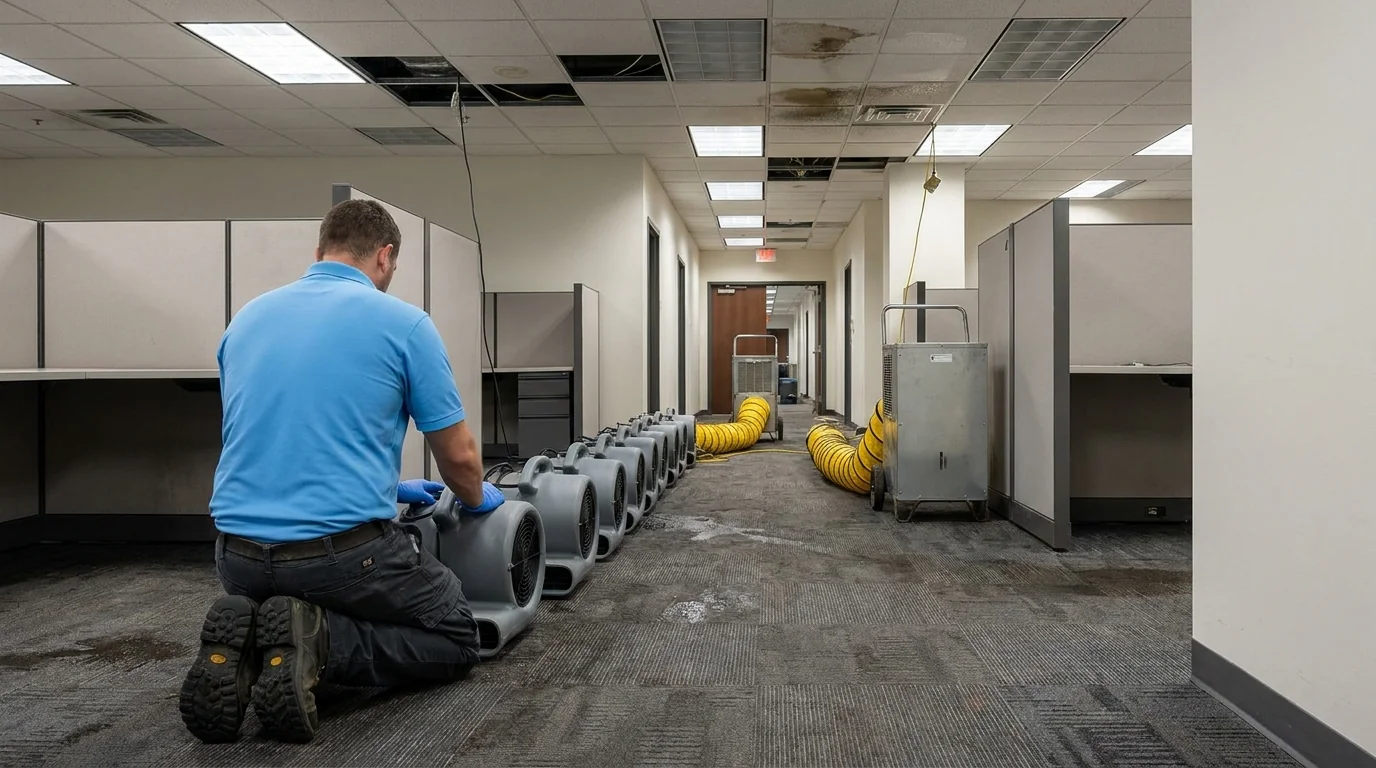
Commercial Restoration in Clifton
24/7 commercial restoration in Clifton, NJ. IICRC-certified, insurance billing accepted. Call (855) 650-7422.
Our IICRC-certified technicians are dispatched from our Fair Lawn, NJ headquarters and are typically on-site in Clifton within 60 minutes of your call.
Along the Route 3 commercial corridor and inside the older brick retail blocks near Styertowne Shopping Center, a burst sprinkler line or an overnight roof failure doesn’t just damage inventory, it can shut down a business for days while the building dries, regulators are notified, and tenants wait for clearance. Commercial restoration in Clifton carries its own set of complications: aging infrastructure, flood-prone geography, and a dense mix of retail, industrial, and multi-family properties that each respond differently to water, fire, and smoke. The Restoration Group responds 24/7, dispatching from Kenilworth to get crews on-site fast and keep your downtime as short as possible.
Why Clifton Commercial Properties Face Elevated Restoration Risk
Clifton’s geography sets the stage for repeated commercial losses. The Passaic River and Weasel Brook hem in the Lakeview and Delawanna sections, and those waterways have overrun their banks during major storm events, most recently during Hurricanes Irene and Ida, pushing water across low-lying industrial lots near Route 21 and into finished lower levels of commercial buildings that were never designed for flood exposure.
Beyond flooding, the building stock itself is a factor. Much of Clifton’s commercial and mixed-use inventory dates to the postwar decades, when cast-iron drain lines and galvanized supply pipes were standard. Those materials are now at or past their service life. A pinhole failure in a supply line inside a drop ceiling can run undetected for days, saturating structural framing and insulation before anyone notices a stain on the tile below. Botany Village’s older brick multi-family buildings present a related challenge: brick and mortar absorb and hold moisture differently than modern cavity-wall construction, which means drying protocols have to be adjusted or moisture gets trapped behind the facade.
Sprinkler discharge is another common source of commercial losses along the Route 3 and Route 46 retail corridors. A single accidental activation, triggered by a heat spike near a kitchen exhaust or a contractor working near a head, can release hundreds of gallons across a retail floor in minutes, saturating product, subfloor, and any tenant space directly below.
Our Commercial Restoration Process in Clifton
When we arrive at a commercial property in Clifton, the first priority is stopping active damage and protecting what can still be saved. That means emergency board-up or tarp service if the building envelope is compromised, followed by immediate water extraction using truck-mounted and portable units capable of pulling standing water from large floor plates quickly.
Once extraction is complete, we map moisture using thermal imaging and calibrated meters, not just the visible wet areas, but the framing cavities, subfloor assemblies, and wall systems that hold water invisibly. In Clifton’s older commercial stock, that step is especially important because original plaster and masonry construction releases moisture more slowly than modern drywall, and drying timelines need to reflect that reality rather than a generic schedule.
For fire and smoke losses, we assess the full path of smoke travel through the HVAC system before any reconstruction begins. Smoke migrates through ductwork and into adjacent tenant spaces faster than most property owners expect, and restoring only the room of origin leaves odor and residue problems that surface weeks later.
Throughout the project, we document every affected material, every reading, and every step taken, a record that supports your insurance claim and satisfies any municipal inspection requirements before the space reopens.
Clifton Insurance Coordination for Commercial Losses
Commercial property claims in Clifton frequently involve multiple parties: the building owner, one or more tenants, a commercial carrier, and sometimes a separate tenant liability policy. We work with all of them. Our documentation package, scope of loss, moisture logs, photographic evidence, and itemized materials, is formatted to meet the requirements of most major commercial carriers, which reduces back-and-forth and helps move the claim toward approval faster.
For properties in the Lakeview and Delawanna flood zones, it’s worth noting that standard commercial property policies typically exclude rising water. If your building carried a separate NFIP or private flood policy at the time of loss, we can coordinate documentation for that claim separately. If coverage is disputed, our scope-of-loss report gives your adjuster and public adjuster a clear, defensible record of what happened and when.
Reaching Clifton from Kenilworth
Our Kenilworth headquarters puts us well inside a practical response window for Clifton. The most direct route runs north on Route 9 to the Garden State Parkway and into Clifton in under 30 minutes under normal traffic conditions, faster off-peak. Because we operate 24/7, we can dispatch at any hour, which matters when a sprinkler discharge at a Clifton Commons-area retail tenant happens at 2 a.m. and the property manager needs someone on-site before the morning shift arrives.
Local Note
One pattern we’ve seen repeatedly in Clifton’s older commercial corridors: buildings with original cast-iron floor drains that have partially collapsed or root-intruded underground. When a water loss occurs and crews attempt to push extracted water toward those floor drains, the drain backs up instead of clearing, turning a straightforward extraction into a secondary flooding event. On any commercial job in Clifton’s pre-1970 building stock, we verify drain function before routing water toward them. It’s a small step that prevents a significant complication.
If your commercial property in Clifton, whether it’s in the 07011 or 07013 ZIP code, along Route 3, or in one of the city’s older mixed-use blocks, has sustained water, fire, smoke, or storm damage, call The Restoration Group at (855) 650-7422. We’ll assess the loss, protect what’s salvageable, and get your business back to operational as quickly as the work allows.
Serving Clifton from our Fair Lawn headquarters — ★ 4.8 · 167 Google reviews
“Great workers, so nice and efficient! And Ottavio is the best” - Emma, October 2026Read our reviews on Google →
Commercial Restoration in Clifton: Service Coverage
Frequently Asked Questions
How fast can you arrive for commercial restoration in Clifton?
Are commercial properties in Clifton's Lakeview and Delawanna sections at higher risk for flood-related losses, and does that affect the restoration process?
How does Clifton's older commercial building stock — particularly the brick multi-family and postwar retail buildings — affect drying timelines?
A sprinkler discharged overnight in our Styertowne-area retail space and affected the tenant below us as well. How does The Restoration Group handle multi-tenant commercial losses?
What should a Clifton commercial property owner do in the first hour after discovering a water loss to protect their insurance claim?
Does smoke from a commercial kitchen fire in one Clifton retail unit typically affect neighboring tenant spaces, and how do you address that?
Commercial Restoration response in Clifton
Most Clifton calls see a technician on-site within 60 minutes from our Fair Lawn headquarters.