24/7 Emergency Smoke Damage Restoration in Clark
24/7 emergency smoke damage restoration in Clark, NJ. IICRC-certified, insurance billing accepted. Call (855) 650-7422.
Our IICRC-certified technicians are dispatched from our Fair Lawn, NJ headquarters and are typically on-site in Clark within 60 minutes of your call.
Smoke damage emergency in Clark? We answer 24/7. Call now and our crew can be on-site within 60 minutes to stop smoke and soot damage from spreading.
After a house fire in Clark’s compact postwar neighborhoods, the visible char is rarely the hardest part to fix. It’s the smoke, the invisible, acidic residue that seeps into the plaster walls of a 1960s split-level off Valley Road, settles into the HVAC ducts of a Brant Lake cape, and keeps releasing odor for months if the cleanup stops at surface wiping. Clark’s housing stock, built mostly between 1950 and 1970, presents specific challenges for smoke damage restoration that newer construction simply doesn’t: original plaster and lathe absorb combustion byproducts differently than drywall, and older forced-air systems can redistribute soot through an entire home in a single heating cycle.
Why Clark’s Housing Stock Complicates Smoke Damage
Most of Clark’s residential streets, the ranches and split-levels clustered around the Lake Avenue corridor, the capes near the Raritan Road business district, were built before modern vapor barriers and sealed construction became standard. That open-cavity construction is efficient at distributing heat in winter, but after a fire it’s equally efficient at distribbing smoke. Soot particles travel through wall chases, settle behind baseboard trim, and collect in the finished basements that are nearly universal in this ZIP code (07066). Those basements often contain original cast-iron ductwork and older mechanical systems that hold odor tenaciously.
The materials themselves matter too. Plaster walls, common throughout Clark’s postwar homes, are more porous than modern drywall. Smoke penetrates deeper into the substrate, which means surface cleaning alone won’t eliminate odor. Restoration work in these homes requires a deeper deodorization protocol: thermal fogging or hydroxyl treatment to reach cavities that a sponge can’t.
Our Smoke Damage Restoration Process in Clark
Every job starts with a full scope assessment before any cleaning begins. We identify the fire origin point, map the smoke migration path through the structure, and test surfaces for soot type, dry smoke from fast-burning fires behaves differently than the wet, oily residue from slow smoldering fires, and the cleaning chemistry is not interchangeable.
From there, the process moves in a deliberate sequence:
- Containment and air scrubbing, HEPA air scrubbers run continuously to capture airborne particulates before they resettle.
- Dry soot removal, vacuuming and dry sponging before any wet cleaning, because introducing moisture to dry soot embeds it further.
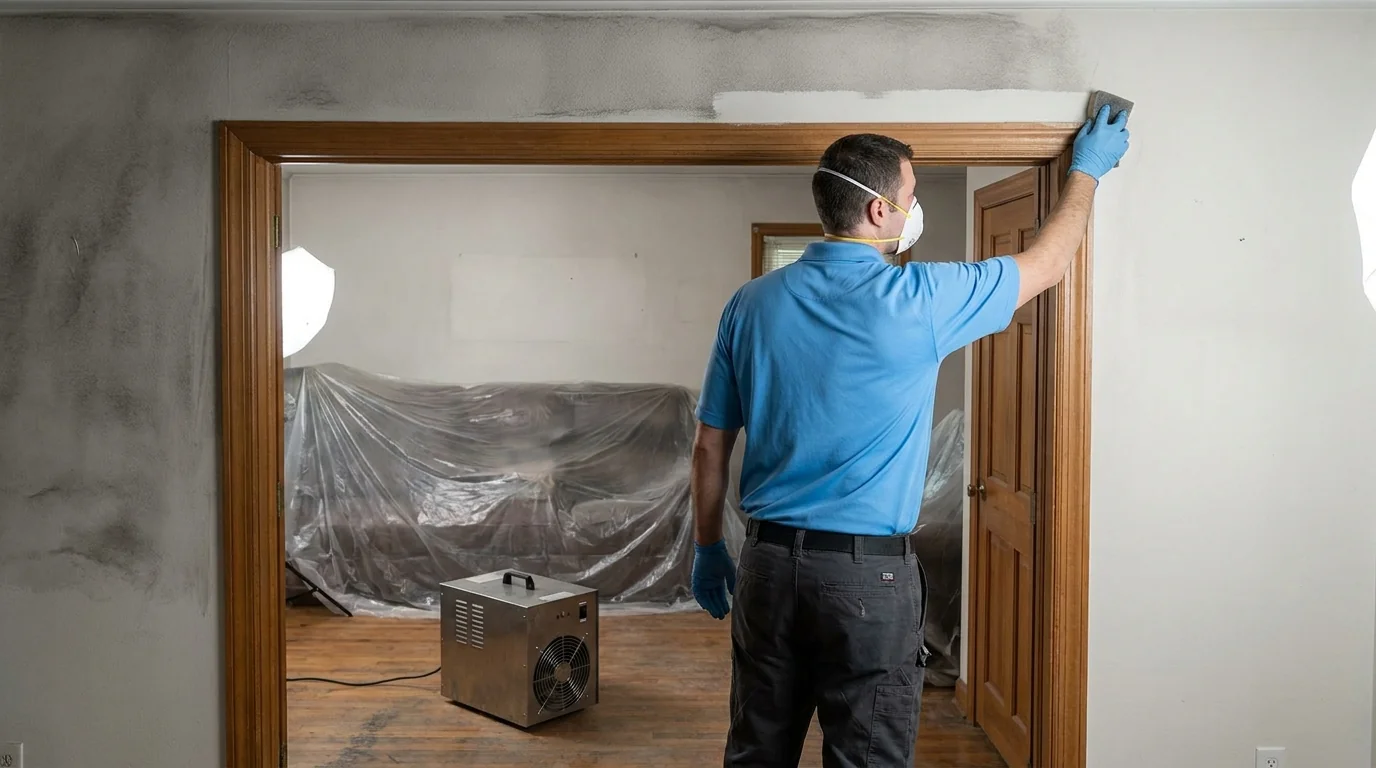
- Surface cleaning, alkaline cleaners neutralize the acidic soot residue on walls, ceilings, and structural members. In Clark’s plaster-wall homes, we use lower-moisture application methods to avoid saturating the substrate.
- HVAC cleaning and sealing, forced-air systems get cleaned and, where necessary, sealed to prevent redistribution of residual particles.
- Deodorization, thermal fogging or hydroxyl generation reaches the wall cavities, ductwork, and finished basement spaces that surface cleaning can’t access.
- Structural drying, if firefighting water is part of the loss, drying runs concurrently under the IICRC S500 standard.
The team is IICRC Certified (Firm #210213), and the process is documented throughout for insurance submission.
Reaching Clark from Kenilworth
The Restoration Group operates out of Kenilworth, roughly three miles from Clark’s eastern edge. Route 28 and Central Avenue are the direct corridors into the Westfield Avenue corridor and the residential streets off Raritan Road. Because the team is available 24/7, dispatch happens immediately on contact, there’s no waiting for a morning call-back window. The short drive means crews can be assessing damage and setting up containment quickly, which matters because soot begins etching porous surfaces, grout, plaster, natural stone, within hours of a fire.
Clark Insurance Coordination
Smoke damage claims in Clark typically run through standard homeowner’s policies under the fire and smoke peril. The Restoration Group documents the loss photographically, prepares a detailed scope of work, and communicates directly with adjusters. As an NJ Licensed Home Improvement Contractor (NJ Division of Consumer Affairs), the company can pull any required permits for structural repairs that follow the restoration phase, which simplifies the handoff between mitigation and rebuild, one less coordination task for a homeowner already managing a stressful situation.
Local Note
One pattern that comes up specifically in Clark’s split-levels and raised ranches: the half-story between the main floor and the finished basement acts as a smoke collection chamber. Because these spaces often have limited HVAC return airflow, smoke from a kitchen or garage fire pools there and isn’t pulled through the system the way it would be in a single-story home. Contractors unfamiliar with this floor plan sometimes miss the odor source entirely and close out a job that smells clean on the main floor but still has active off-gassing in that intermediate level. During scoping, we specifically probe those interstitial spaces with a combustion-particle meter before finalizing the cleaning plan.
If smoke has moved through your Clark home, whether the fire started in the kitchen, the garage, or a neighboring unit, the damage extends well past what you can see. Call The Restoration Group at (855) 650-7422 to schedule an assessment and get a documented scope before odor and residue cause permanent staining or etching to the surfaces you care about.
Serving Clark from our Fair Lawn headquarters — ★ 4.8 · 167 Google reviews
“The company was very prepared and professional. They were prompt with coming out to inspect the water damage that occurred and had the team come out the next day. They even wore booties in the house. They cut out all areas of damage, sprayed and use numerous fans and humidifiers in the wet area. I…” - Melanie, October 2026Read our reviews on Google →
Smoke Damage Restoration in Clark: Service Coverage
Frequently Asked Questions
How fast can you arrive for smoke damage restoration in Clark?
How quickly can The Restoration Group reach homes near the Brant Lake and Valley Road areas of Clark?
Clark's older split-levels and ranches have plaster walls — does that change how smoke residue cleanup works?
Are homes along the Westfield Avenue corridor in Clark 07066 more likely to have smoke spread through their ductwork?
What's the difference between dry smoke residue and wet smoke residue, and which is more common after typical Clark house fires?
How does The Restoration Group handle insurance documentation for smoke damage claims on Clark properties?
Smoke Damage Restoration response in Clark
Most Clark calls see a technician on-site within 60 minutes from our Fair Lawn headquarters.