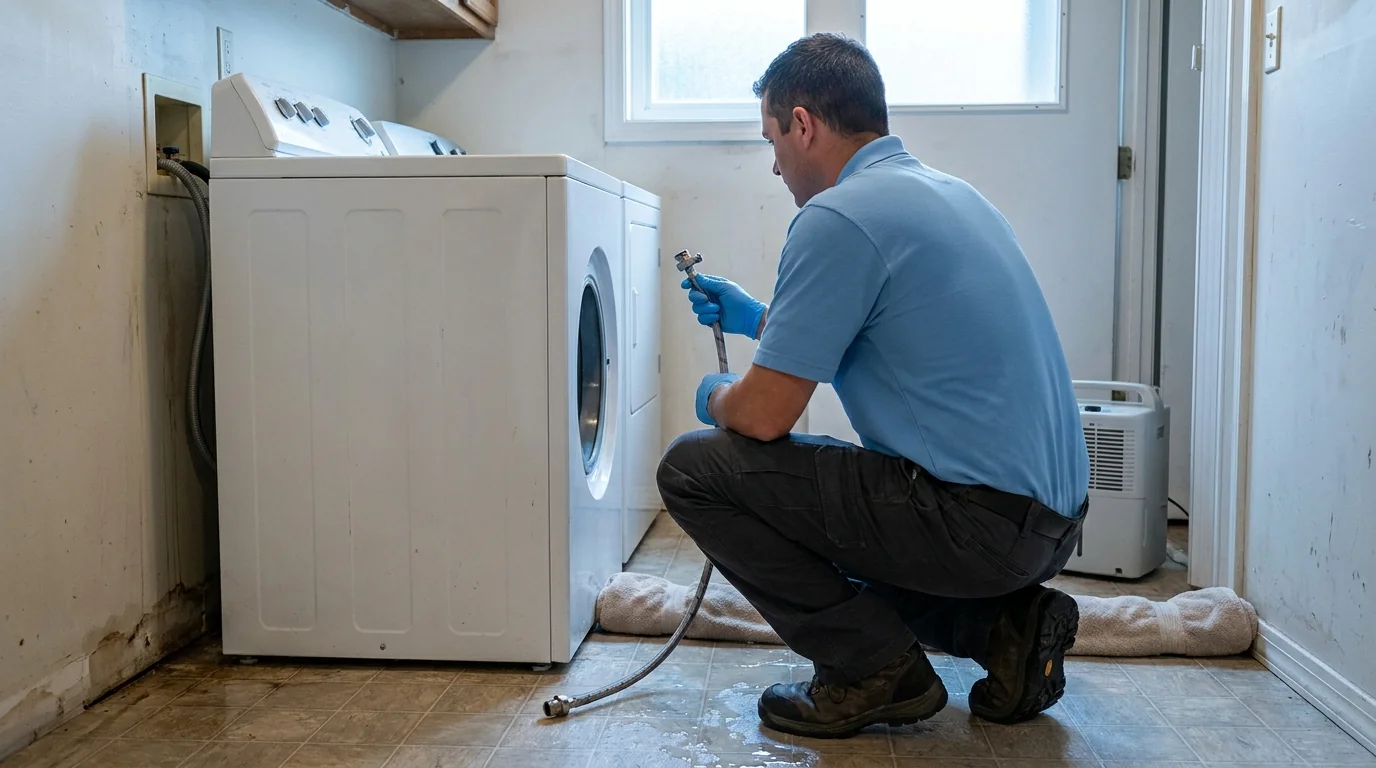
24/7 Emergency Appliance Leak Cleanup in Clark
24/7 emergency appliance leak cleanup in Clark, NJ. IICRC-certified, insurance billing accepted. Call (855) 650-7422.
Our IICRC-certified technicians are dispatched from our Fair Lawn, NJ headquarters and are typically on-site in Clark within 60 minutes of your call.
Burst pipe or leak in Clark? We answer 24/7. Call now and our crew can be on-site within 60 minutes to stop the water and start the cleanup.
Clark’s compact postwar neighborhoods sit on finished basements that were never designed for the appliances now running inside them, and when a washing machine supply hose lets go or a refrigerator ice maker line splits behind the wall, water finds the path of least resistance straight down into that finished space. The 1950s and 1960s split-levels and ranches lining streets off Valley Road and the Lake Avenue corridor were built before modern water-supply braided hoses existed, and their original copper lines and cast-iron drains are well past the age at which failures become routine. The Restoration Group responds 24/7 to appliance leak emergencies throughout Clark, NJ 07066, and the team carries IICRC Certified Firm credentials (#210213) along with an NJ Licensed Home Improvement Contractor license.
Why Clark Homes Are Especially Vulnerable to Appliance Leaks
Clark’s housing stock tells the story. The borough’s split-levels and cape cods were built in a single postwar construction wave, which means a large share of homes are aging together, copper supply lines corroding at fittings on the same schedule, flexible drain hoses on dishwashers that were last replaced during a Clinton-era kitchen remodel, and water heaters installed in utility closets adjacent to finished rec rooms with no drain pan beneath them. When a water heater in one of those setups fails, it doesn’t just puddle; it saturates the subfloor and wicks into the framing before the homeowner smells anything.
The geography compounds the problem. The Robinson’s Branch tributary threads through low ground near Lake Avenue, and the soil in that corridor stays saturated well into spring. Homes in that area carry elevated hydrostatic pressure against their foundation walls, which means even a modest appliance leak, a slow drip from a refrigerator water line, for example, can meet groundwater migrating through block mortar and produce far more moisture inside the wall cavity than the leak volume alone would suggest. After Ida in 2021, backed-up sewers off Valley Road added a contamination layer to what started as clean-water appliance losses in several homes, a pattern the team has seen repeat in wet summers since.
Our Appliance Leak Cleanup Process in Clark
The first step on any appliance leak call is source confirmation. Technicians identify whether the loss is still active, a supply line, a drain connection, an ice maker feed, and isolate it before any drying equipment goes down. In Clark’s finished basements, that often means pulling back carpet and pad to assess whether the subfloor has delaminated and checking the perimeter wall framing with a moisture meter, because water that travels laterally under a slab edge is easy to miss on a visual inspection.
Once the scope is mapped, the team sets commercial-grade desiccant or refrigerant dehumidifiers and axial air movers calibrated to the room’s cubic footage. Drying is documented daily with psychrometric readings, temperature, relative humidity, and material moisture content, so there’s a defensible record for your insurance adjuster. Affected materials that can’t be dried in place (saturated insulation, delaminated subfloor panels, wet drywall below the flood cut line) are removed and disposed of before the drying phase begins, not after, because leaving them in place extends drying time and raises the mold risk. In Clark homes with cast-iron drain lines, the team also checks whether the drain itself is the source of a recurring backup rather than the appliance, since misdiagnosed drain failures account for a notable share of repeat calls in older suburbs like this one.
Reaching Clark from Kenilworth
The Restoration Group’s base in Kenilworth puts Clark within a short drive via Central Avenue or Raritan Road, and the team runs 24/7, so calls that come in overnight or on weekends reach a live dispatcher who can roll a crew. The Raritan Road business district and the Westfield Avenue commercial corridor are both reachable quickly, which matters for restaurant and retail losses where standing water in a kitchen or storage room compounds with every hour it sits. Residential calls in the neighborhoods around Arthur L. Johnson High School and the Brant Lake area are similarly accessible, no major highway crossings or bridge bottlenecks between Kenilworth and most Clark addresses.
Local Note
One thing worth knowing about Clark’s split-levels specifically: the intermediate floor between the garage and the main living level is often where the washing machine lives, and that floor assembly typically has no waterproofing membrane beneath it, it was built as a structural floor, not a wet area. When a washing machine floods on that level, water moves through the subfloor and into the garage ceiling below faster than it would in a basement setup, and it can reach electrical boxes in the garage ceiling before it’s visible anywhere. On calls in Clark’s split-level stock, the team checks the garage ceiling cavity as a standard step even when the homeowner reports the water stayed on the laundry level, because in these homes, it rarely does.
If you’re dealing with an appliance leak anywhere in Clark, whether it’s a dishwasher that ran overnight, a water heater that let go in a finished utility room, or a refrigerator line that’s been seeping behind cabinetry for weeks, call The Restoration Group at (855) 650-7422. The crew arrives with the equipment and the documentation process to dry the structure correctly and give you a clear record for your insurance claim.
Serving Clark from our Fair Lawn headquarters — ★ 4.8 · 167 Google reviews
“The company was very prepared and professional. They were prompt with coming out to inspect the water damage that occurred and had the team come out the next day. They even wore booties in the house. They cut out all areas of damage, sprayed and use numerous fans and humidifiers in the wet area. I…” - Melanie, October 2026Read our reviews on Google →
Appliance Leak Cleanup in Clark: Service Coverage
Frequently Asked Questions
How fast can you arrive for appliance leak cleanup in Clark?
How quickly can The Restoration Group reach homes near Lake Avenue and the Valley Road corridor in Clark?
Clark's split-levels often have the washing machine on an intermediate floor — does that change how cleanup works?
Are homes in the Brant Lake area of Clark more prone to appliance leak damage spreading into the foundation?
What's the timeline for drying out a finished basement after a washing machine flood in a Clark ranch or split-level?
Will my homeowner's insurance cover appliance leak cleanup in Clark, and does The Restoration Group handle the documentation?
Appliance Leak Cleanup response in Clark
Most Clark calls see a technician on-site within 60 minutes from our Fair Lawn headquarters.